 Editorial Team
Key Takeaways
- Morocco’s claim on Ceuta and Melilla guarantees constant friction with Spain, turning every border issue into a sovereignty dispute.
- As an EU-Africa land border, the enclaves are a bottleneck for migration, forcing Spain and the European Union to manage thousands of crossing attempts each year.
- Local economies are on a knife-edge, utterly dependent on their unique border status and Morocco’s on-again, off-again willingness to allow cross-border trade.
- Heavy Spanish military and police presence is a given, a response to security concerns ranging from border breaches to counter-radicalization efforts.
- What happens next hinges on fragile Spanish-Moroccan diplomacy and the EU’s ever-changing migration policies, which will directly hit the enclaves first.
On the northern coast of Africa sit Ceuta and Melilla, two Spanish autonomous cities that are a constant geopolitical headache. They’re European outposts on another continent, and that simple fact creates a permanent tug-of-war over diplomacy, migration, and trade with their only neighbor, Morocco. To get a grip on the messy geopolitics of these Spanish enclaves, you have to dig into a history of Spanish rule, their value as strategic outposts, and the intense pressures from migration and Moroccan sovereignty claims that define them today.
Historical Roots and Enduring Sovereignty
The history here is long and tangled, going back way before anyone was talking about modern nation-states. Ceuta, sitting right at the Strait of Gibraltar, became Portuguese in 1415 before Spain took over in 1668. Melilla, farther east, has been Spanish since 1497. Spain hammers on these dates because they establish a claim long before Morocco became an independent nation in 1956. That’s the core of its legal argument. Morocco, of course, sees it differently. It considers the enclaves stolen territory, much like Spain feels about British-held Gibraltar. This creates a diplomatic deadlock that never really ends. Spain’s position is that Ceuta and Melilla are just as Spanish as Andalusia or Catalonia. Their residents are full Spanish citizens who vote in national elections, and the Spanish Constitution of 1978 codifies their autonomy. But Morocco’s Ministry of Foreign Affairs, African Cooperation and Moroccan Expatriates officially calls them “occupied territories” that must be returned. This core conflict poisons the well for almost every interaction, like when Morocco is accused of loosening its border controls to pressure Madrid during a political dispute. Most countries just accept Spain’s de facto control, but the fight is always simmering beneath the surface of Spanish-Moroccan relations. If the cities’ status ever changed, the fallout would be huge. For Spain it’s a loss of sovereign territory, for Morocco a major national victory, and for the European Union it would mean redrawing its external border from scratch. These aren’t museum pieces. They’re bustling communities where Spanish and North African life collides daily.
Migration Crossroads: A European Frontier
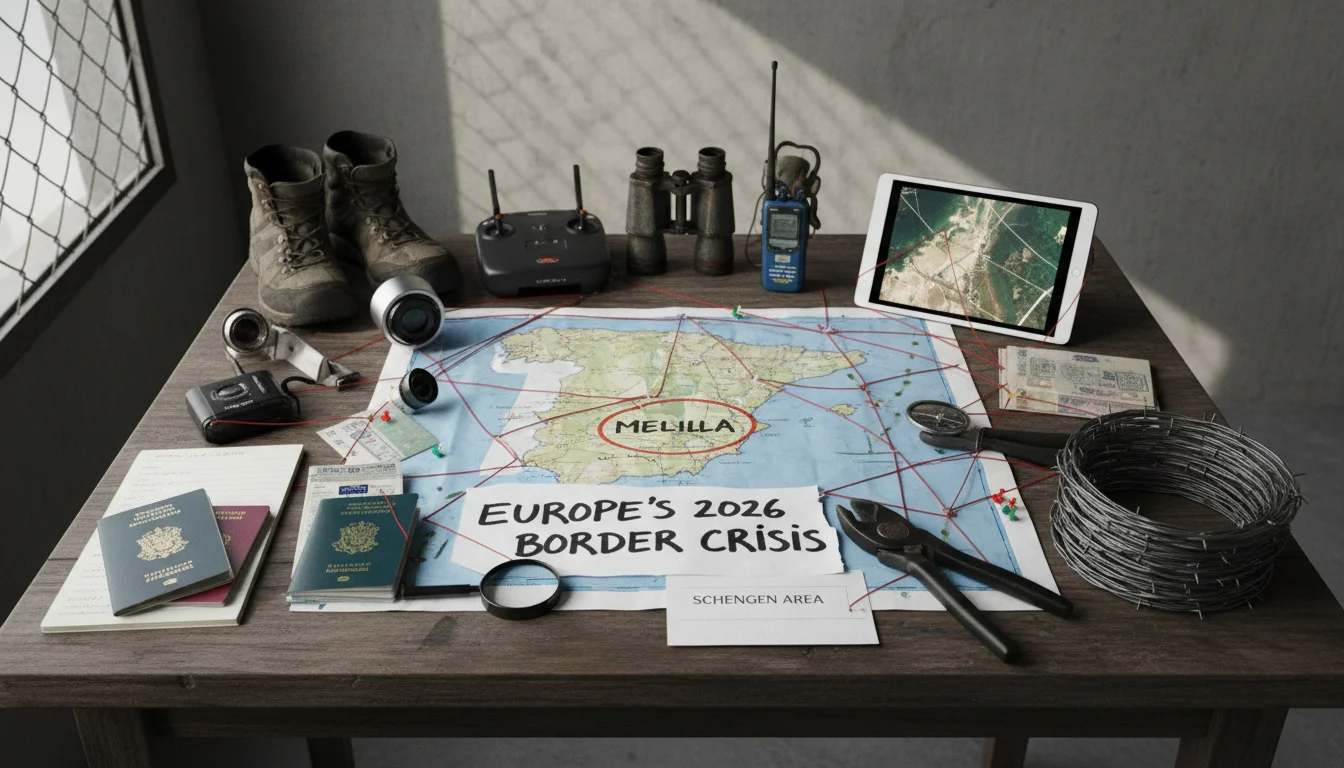
The most obvious sign of tension is the border itself, which makes Ceuta and Melilla a primary funnel for irregular migration into Europe. Thousands of people, mostly from sub-Saharan Africa but also from North Africa, try to get into the enclaves every year. The land borders are no joke, featuring triple-fences, coils of razor wire, and constant surveillance, but even that often isn’t enough to stop people who are desperate enough. The pressure can be unbelievable. Just look at May 2021, when around 10,000 people, a lot of them kids, poured into Ceuta in less than 48 hours. That event, which Reuters and others covered extensively, showed just how porous the borders can be. Spain openly accused Morocco of orchestrating the surge by relaxing its own controls as payback in a diplomatic fight. Morocco denied it, but the incident showed how migration has become a bargaining chip. Spain throws a ton of resources at this, the Guardia Civil and National Police are everywhere, backed by high-tech surveillance systems, and the EU kicks in funds for border management. They’re recognized as external EU borders, after all. Still, human rights groups constantly criticize the methods, pointing to the walls and the quick deportations as potential violations of international law. The real dilemma is trying to secure a border while meeting humanitarian duties, a nearly impossible task when your neighbor can, as Spain alleged in 2021, turn the tap of migration on or off to make a political point.
Economic Interdependencies and Cross-Border Trade
The economies of Ceuta and Melilla live and die by their unique geography and political status. For years, they did well as free ports with low taxes, acting as commercial depots for goods flowing into Morocco. This model let them import products with low tariffs, which were then carried and resold across the border. But that whole economic engine has been sputtering. Morocco has been cracking down, especially on the informal trade that propped up countless families on both sides of the line. In late 2019, it shut down the so-called “mule trade,” where porters would physically carry bundles of goods across the border. Rabat said it was about stopping smuggling, but the move devastated local businesses in Ceuta and Melilla, causing shops to close and jobs to disappear. Tourism is still a thing, mostly for Spaniards from the mainland drawn by the duty-free shopping and unique cultural mix. But the hard reality is that both cities depend heavily on subsidies and public-sector jobs from the Spanish government, while constantly having to renegotiate their economic relationship with Morocco. Can they survive long-term? It will probably require a complete rethink away from just being a trade post, maybe shifting to specialized tech services or a more developed tourism sector. Pivoting isn’t simple, though. The cities are structurally dependent on subsidies from Madrid, and Morocco holds all the cards when it comes to cross-border commerce.
Security Dimensions and Regional Stability
The security file for Ceuta and Melilla goes way beyond migration. Being in North Africa puts them on the front line against threats flowing out of the Sahel, from terrorist groups to organized crime and drug trafficking. Spain has a heavy security footprint here, with military garrisons and intelligence units working to stop threats before they materialize. Even with all the fortifications, the border is a potential route for smuggling drugs, weapons, or people with violent intentions. That means security collaboration with Moroccan authorities is absolutely essential. The problem is that it’s notoriously inconsistent, it can be switched on or off depending on the diplomatic mood in Rabat and Madrid. When relations are bad, cooperation gets spotty, and that creates real security gaps. There’s also the internal threat of radicalization. Like any border area with economic stress and a diverse population, the enclaves are places where extremist ideas can take root. The Spanish government runs community policing initiatives and social programs to try and keep a lid on it, but the risk is always there. The security of these two small cities isn’t just Spain’s problem. An attack or major instability there is an attack on an external border of the Schengen Area. So an unstable neighborhood has direct consequences for Europe, and these two outposts are sitting right in the middle of it.
The Future of the Enclaves: Diplomacy and Adaptation
The future here is all about the relationship between Madrid and Rabat. Spain will never negotiate sovereignty, but it has to talk to Morocco to manage the border, keep trade flowing, and work together on security. The last few years have been a rollercoaster of high tension and then fragile peace. In 2022, the two countries started a new diplomatic chapter, promising mutual respect and cooperation after Spain shifted its long-standing policy on Western Sahara, a move that pleased Rabat. Those kinds of top-level diplomatic deals have an immediate effect on the ground in Ceuta and Melilla, easing or tightening the border overnight. Looking ahead, these cities have to figure out how to survive if the old economic models are dead for good. That means building stronger local economies, finding ways to better integrate their different communities, and dealing with the migration issue with a mix of firmness and basic humanity. For Spain, it’s a permanent tightrope walk: it has to project absolute control over its territory while keeping its only African neighbor happy enough to cooperate on migration and security. It’s a contradiction they live with daily. As long as Ceuta and Melilla are on the map in North Africa, they’ll remain a flashpoint in Mediterranean geopolitics.
What is the primary dispute over Ceuta and Melilla?
The dispute is a sovereignty clash. Morocco claims the cities as integral parts of its national territory, while Spain asserts its right to them based on centuries of rule and their status as autonomous cities within the Spanish Constitution.
How do Ceuta and Melilla function as EU borders?
They are external land borders of both the European Union and the Schengen Area. This means they are a focal point for EU border policy and receive EU funding to help control the flow of irregular migration into Europe.
What economic role do Ceuta and Melilla play?
They’ve historically been free ports, acting as commercial hubs for trade with Morocco. Now, their economies are a shaky mix of Spanish public sector jobs, tourism, and a very fragile cross-border trade that Morocco has severely restricted.
What are the main security concerns in the Spanish enclaves?
Key concerns are managing huge migration pressures at the border, fighting organized crime and human trafficking, and preventing terrorist threats or local radicalization. This requires a large and permanent Spanish security force.
How do diplomatic relations between Spain and Morocco affect Ceuta and Melilla?
They directly impact everything on the ground. When relations are good, the border operates more smoothly and security cooperation improves. When relations are tense, Morocco has been known to use border controls and migration as political use, directly affecting the enclaves.


